
HOMECLIENT LOGINONLINE STOREASSESSMENTS
X
“The teaching comes from Jim Lucas, an internationally recognized authority on leadership and organizational life. . . . You can take what he says to the bank – both figuratively and literally.” -Steve Forbes

Swift Energy and Cary Stockdell – Making a Difference with People

Published: March 26, 2012

From time to time, we enjoy telling the world about the great success of a Luman International client, and in particular how their application of key leadership principles has made a huge difference in their performance and results.  Here we’d like to give a shout out to Swift Energy, a U.S. energy company based in Houston, and to its driver of organizational development, Cary Stockdell. 

In honor of Cary’s work since joining Swift in 2007, he was recently declared “HR Leader of the Year (company size 0-1,000)” at Houston’s 7th Annual Impact Awards Ceremony.  Given the size and diversity of the Houston business community, this is an outstanding achievement by Cary.  After working with him since 2007, we can add that it was well deserved.

His biography in the award program said that Cary has “played a strategic role and has a seat at the management table.  Cary is a trusted advisor of the executive leadership team and serves as a mentor to many up and coming staff.  He is setting the standards for a top-tier training and development program.  Cary has helped grow the leadership of a compoany that has been in existence for over 30 years, something not common for the Oil and Gass industry.  He helped to make a team out of a group of people, impacting the company’s success.”

We have had the pleasure of working with Cary since 2007 in his efforts to take a long-standing, successful company to the next level.  He is never comfortable with the status quo, and immediately began challenging executive leadership, senior leadership, and team members to learn and apply new principles and practices.  All too rarely for someone in his role, he quickly became a trusted advisor to executive leadership.  He used that position to move people out of a comfort zone and into a “collaboration for excellence” zone.  He outlined a “Road to the Future” that was thoroughly embraced by leadership at all levels, and as time passed by team members at all levels.  He led the charge in helping a fine group of professionals turn themselves into an even finer team.

We have been most pleased with the terrific progress made by the Swift team.  They have absorbed new leadership thinking, principles, and practices and have turned them into a deeper sense of commitment and a higher level of results.  They created a fresh VMVB (Vision, Mission, Values and Behaviors) to focus the organization and prepare it for future growth and opportunities, and are working hard to live it.  The executive leadership team – Terry Swift, Bruce Vincent, Alton Heckaman, Bob Banks – have been fearless in allowing us to assess their progress (quantitatively and qualitatively), and then in facing and embracing the truth, and then in taking actions to improve. 

Change is always hard, but Swift and Cary have made change a valuable component of their success.  The Luman principle is that “Either you’re exploiting change, or change is exploiting you.”  This great group-turned-team is now in the business of exploiting change.  We call our leadership program the Diamond of Excellence, and 5 years of passionate, hard work by the people at Swift has advanced them to a Diamond of Excellence level.

Congratulations to Swift Energy and to Cary Stockdell for their remarkable achievments.  It couldn’t happen to a better team.

Note: Italicized terms are trademarked property of Luman International.  All rights reserved.


Problem-Solving Facilitation

Published: January 31, 2012

I (James Lucas) just sat through a conference that was so excruciatingly boring it could be used either to produce medically induced comas or to get terrorists to talk.  It was advertised as a problem-solving, solutions-oriented, strategic thinking conference.  This is akin to calling the clown-stuffed car at the circus “thoughtful entertainment.”

The problems with this conference were legion: no new thoughts, no takeaways, no meaningful discussion.  They actually thought they could spend 3-4 hours doing “breakouts.”  Now, a breakout can be a good thing, if there has been content given to set it up, if there is a thoughtful exercise, if there is time to discuss the topic thoroughly, and if the report-out is well done.  That’s a lot of ifs, though, and these facilitators hit none of them (we have seen very few facilitated sessions that hit all four of these, but this one was special). 

The exercise, with no setup, was to have each person at a table fill in an “absurd” solution to a given problem on a 4-quadrant page.  Then these sheets were picked up and handed to people at another table, who were told to fill in a less absurd follow-up to the absurd “solution.”  Then back to the first table to fill in the 3rd quadrant with a more reasonable follow-up, and…well, you get the idea.  They gave people 1-2 minutes to do their fill-ins, which minimized actual thought, and allowed no time for discussion at the table, which minimized development of the idea (but maximized disinterest).  Report-outs were handled as a “pick one at your table to share.”  They were as lively as a day at the dentist.

What is this so-called “adult learning method” all about?  Well, like so many of these methods, it’s trying to be cute but it’s too clever by half.  It leaves people and their needs out of the equation, and is more concerned about busywork than about improving work.  It doesn’t matter how your facilitation and breakouts are structured if no one gets anything useful out of it.

At Luman, we have a simple yet sophisticated approach to facilitation.  We start with provocative content, designed to challenge status quo thinking and to get people to give up their illusions and face reality, all part of our Diamond of Excellence development model.  Then we break people into groups based on the content they’ve just heard and ask them to have a wide-ranging, dynamic, no-holds-barred but guided conversation.  We tell them that each group has to come up with at least 5-8 ways to use or implement the content.  And then we have a detailed report-out driven by a facilitator who can add even more to the discussion as it evolves.  Lots of depth, lots of takeaways, lots of interest.

Adults in organizations don’t need “adult learning” methods that simply get people to complete an exercise that has no value to the participants.  The conference I attended today made it even worse by being so incredibly boring, but “interesting yet useless” is still not worth very much.  The key is good adult-learning methodology tied to first-class content. 

If you want rich content followed by rich dialogue, leading to real ideas to improve your organization, Luman has what you need.  But if you want cute and worthless, contact us and we’ll give you the name of today’s conference facilitator.

Italicized terms are trademarked property of Luman International.  All rights reserved.

Good Enough…Isn’t

Published: January 11, 2012

How often do we hear the comment, “It’s good enough” or some variation of it – that’s fine, that’ll do, that gets the job done?  I like to kid my Oklahoma friends about the motto, “Oklahoma, OK.”  OK?  We’re average?  Right in the middle?  Nothing special?

 The big problem with this isn’t the specific instance – often, what’s been done is enough and spending any more time or resources on it isn’t productive or valuable.  The big problem is the mindset it creates in actual human beings.  It sets the bar too low, and we’ll end up getting “good enough” even on work where it isn’t.  With people, we tend to get what we expect (or less).  If we expect average or okay, we’re going to get average or okay (and even that only if we’re lucky).

At Luman International, we created the concept of Pure-Performance.  We came to hate not only “it’s good enough” but “let’s work for high performance.”  ”High” is too often subjective.  Higher than what?  Last year, last quarter?  Everyone facing bankruptcy?  Higher than whom?  Our peers?  The biggest people in our market?  Google?  Apple?  We can always find someone or something that we can be “higher” than.  It doesn’t mean the comparison is worthless, or even wrong.  It just means that we’re setting the bar too low, or maybe too fuzzy.  The output is not likely to be labelled “great.”

Pure-Performance says, “Good enough isn’t.”  It lines up with football legend Vince Lombardi’s guidance, “Aim for perfection, and you might end up with excellence.”  It urges us to throw out everything that isn’t producing results, adding value, or leading to improved performance.  If it isn’t leading to something useful and great, why on earth are we doing it?  We might not be able to weed out all of the useless activity, but we’re sure going to be a better organization if we try.

The vast majority of training and leadership development misses this mark almost entirely.  Even worse, it often forces everyone toward the “norm:”  “This is how leaders act/should act.  Go and do likewise.”  But in our 29 years of working with hundreds of organizations, we can say with absolute certainty that most leaders are leading something that is 20 or 30% performance and 70 or 80% nonsense.  They don’t even try to build the pillars of performance into their cultures, or to drive out the barriers to performance (even if they knew what they were).  Organizations that have managed to survive for decades – in part because their competitors are even more clueless – are wasting resources and exposing themselves at some point to organizational disaster.

Examples?  Recent ones are:

  • Kodak – facing bankrupty from the digital onslaught, even though they invented it – more available in digital than just a short time ago, but not “high” enough to save them
  • Barnes & Noble – coming to dominate the bookstore market just in time to watch it become burdensome, costly, and a distraction from the digital world and the introduction of their Nook (but at least they were operating “higher” than Borders!)
  • Circuit City – trumpeted by Jim Collins as one of the 11 “Good to Great” companies right before they shuffled off this mortal coil
  • Fannie Mae – dominating the mortage market right before they helped destroy the mortgage market and themselves (also a “Good to Great” company)

These were all once great companies, operating at a “higher” level than their competitors.  Higher didn’t save them.  They all had way too much waste, misdirection, and focus on the wrong things.  They not only didn’t get to Pure-Performance  – they didn’t even know what it was.

Pure-Performance.  There are keys to getting it, and things to avoid like the plague if we want it.  We encourage you to stop worrying about high performance.  Enter the world of pure-performance instead – different in kind, not just in degree.  There is leadership and market dominance in people who go through that door.

Italicized terms are trademarked property of Luman International.  All rights reserved.

The Bell Curve – Great Tool for Things, Terrible Tool for People

Published: December 14, 2011

Bell curves are terrific tools in the right application - for example, in statistical analysis and quality management.

But as so often happens in leadership and life, a wonderful tool for managing things can turn ugly when we apply it to people.  People aren’t things.  They don’t respond in a linear, cause-and-effect way, they have passions and emotions, they can even respond negatively to being evaluated with a statistical tool.  Unlike systems, people can fix themselves – they can lose bad attitudes, stop making mistakes, improve performance, offer creativity where none was even expected, grow and mature.

Bell curves build in artificial distinctions between people.  This person is an A (high performer) or a C (low performer) or a B (okey-dokey performer).  There they are, clearly pegged, labelled, categorized.  But an A can become cocky and arrogant and put our organization at great risk.  They can leave for greener pastures.  They can treat other people like inferiors.  A C can have an epiphany if we haven’t beaten them down and cast their C-ness in concrete.  And a B - classified as average, maybe high average, maybe low average – can resent their status.  They can go be an A somewhere else, or stay with us and sink into the abyss of C-ness. 

Entire performance evaluation systems are built around this destructive bell-curve mindset.  As a leader, even if all of your people are operating at an A level, you can only rate a small percentage as an A.  A lot of A’s are called B, with all of the discouragement and anger that this can produce.  A few even have to be called C, which is worse than wrong – it’s stupid.  A high B can legitimately ask, “What can I do to become an A when I’m already doing everything I know how to do?  Low B’s and C’s can legitimately ask, “What’s the point of working here?”

And why on earth would any leader want a Bell-Curve Organization?  Shouldn’t we want as many people as possible operating at an A level?  We’re never going to get everyone there – there will always be the 5% – but one of the most important differences between good and great leaders is the wisdom to know that you can’t achieve top-tier performance with just 10 or 15% of your people operating at an A level, no matter how good they are.

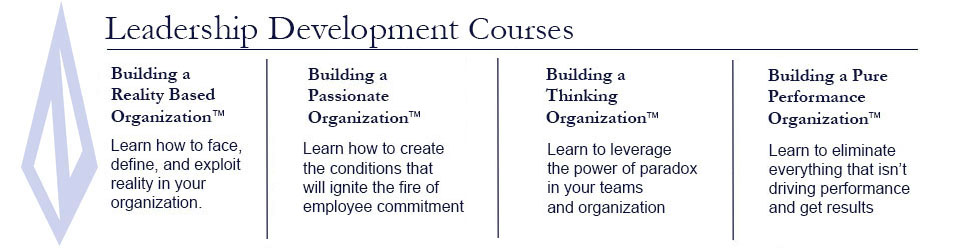
At Luman, we’ve built our courses and assessments around helping leaders break the bell curve mindset and instead go about Building a Passionate Organization.  You can end up with an S-curve skewed to the right – 95% “all in,” 5% needing to move forward or move out.

Jack Welch gave us a lot of outstanding leadership concepts.  The Bell Curve for People?  Not one of them.  If you’ve fallen for it, you can lose it today.  That would not be too soon.

Note: All italicized terms are trademarked property of Luman International.  All rights reserved.

Sprint, Poster Child for Dysfunctional Culture

Published: November 29, 2011

Sprint became an early and dominant player in telecommunications.  They seemed to have it all going for them, as they built a headquarters campus roughly the size of Paris.  It turns out that they should have spent that money on fixing their culture and its strategy (culture’s natural outflow).

Since 2007, when the current CEO took over to “fix” the company, the S&P has lost roughly 18% of its value.  Sprint has lost 80%.  Their current “strategy” involves paying $600 for IPhones (over $30 billion worth) and selling them for $200, which should give them a breakeven point around the mid-point of the century.  The board, we’re told, wrestled with this.  The real question is, ”Why weren’t they laughing?”  They do have a parallel strategy – suing AT&T over its potential merger with T-Mobile.  You know when your approach to competition is to use the federal government as a hammer on your peers that you are at the ugly end of your life.  As a bonus, they’ve managed to get the approach to lawsuits changed, so the government can now allow, invite or encourage competitors to join in anti-trust suits.

What went wrong?  The same thing that continues to go wrong.  James Carville told Bill Clinton that “It’s the economy, stupid.”  In organizational life, “It’s the culture, ….”  Sprint is notorious for paying people a lot of money to do nothing, creating a non-competitive, entitled culture.  At the same time, it managed to change course and lay off so many people so many different times that it created a personally competitive, fearful culture.  A lot of people with no real voice, fighting to be the last one standing.

Culture is king.  If it is designed well, it can lead to great things as you go about Building Passionate, Thinking, Pure-Performance Organizations.  Smart, experienced people – of which Sprint has had very many – can commit, trust, challenge, innovate, and talk about the truth, all on the way to building something that doesn’t make incomprehensible decisions and take wildly unproductive actions.  I have met many current and former Sprint employees, and I almost always think 2 things: 1) What a potential powerhouse, and 2) What a waste.  Good people get locked into the pay and benefits, even as they get locked into a cultural death spiral.

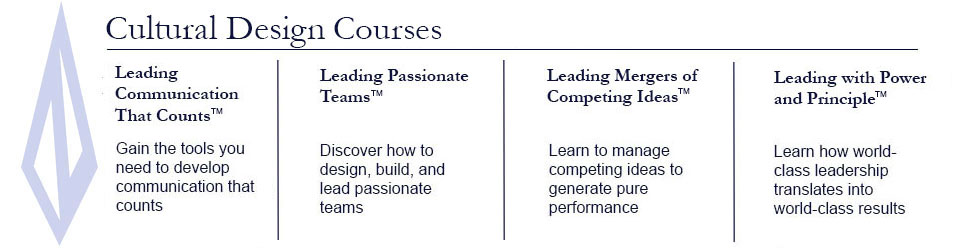
What’s the solution?  It’s all about what we call Cultural Design.  We have spent nearly 30 years looking at hundreds of organizations and thousands of leaders up close and personal.  We’ve seen what works and doesn’t work to produce a culture that not only yields pure-performance but does it in a sustainable and continuously renewable way.  The Sprint board made the mistake of thinking it was all about marketplace strategy and having a strong CEO who likes to be on television.  But it isn’t.  It’s all about a culture that is so strong, so dynamic, so honest, so intelligent, so focused on results that if there’s a way to win it will find it.

Sprint is a current extreme example of dysfunctional culture, but great leaders realize that the default position on culture is dysfunctional.  Without design, without building in the 40 attributes that define a truly winning culture, as a leader you get whatever human nature can serve up – seldom at its best, often at its worst.   With good design, as long as you have a real market to serve, good results are as sure as the turning of the earth.

Note: Italicized terms are trademarked property of Luman International.  All rights reserved.

First Things Only

Published: November 16, 2011

You know, there’s a lot of truth and value in the old expression, “First Things First.”  It reminds us that there are first things, things that are more important than the mountains of activities and detail that continually demand our attention.  It reminds us that we should put those first things at the head of the line.  And it reminds us that we have to make a point of it or this just won’t happen.  It also tells us something else that’s very important - that it takes mindfulness and effort to keep those first things at the top of the list of where we spend our time and energy.

In the actual world we live in, however, first things are often not put first.  Sometimes, they’re not in the middle of the list, or even on the list.  At times, first things are the last things that get people’s attention.  Why is this?  Well, partly because first things are often hard things.  They’re big and tough and difficult to get your arms around.  They take attention that we don’t seem to have, collaboration that we can’t seem to develop, passion that we just can’t muster.  Partly first things need a lot of focus and concentration to make something out of them, and the 21st century doesn’t leave much room for those.  Partly, we haven’t even defined first things as first things.  And partly, we often don’t even know where to begin.

But first things are where the game is won or lost.  That’s where the 80/20 rule really works – 80% of the results from drilling down on 20% of the decisions and actions.  It can even be the 90/10 or 95/5 rule, where very, very few things really make all the difference, where almost all of the results come from just one or two things done exceedingly well.

This is why, at Luman International, we say First Things Only.  If it isn’t a first thing, why are we working on it?  Or to say it differently, why are we working on anything else when there’s a first thing floating around that hasn’t been fully addressed?

But what really happens in organizations?  I was talking with the Senior VP of HR in a Fortune 500 company, who told me that his “first thing” was to create a sense of passion and commitment, and in the process to elininate their pervasive sense of entitlement and “doing only what I have to do.”  I gave him a lot of ideas about how to go about Building a Passionate Organization, something we’ve been helping leaders do for almost 29 years, something that should be on every leader’s list of First Things.  When I met with this executive some weeks later, I asked him what he had been working on.  His answer?  “I’ve spent every waking minute since then trying to get our new physical education/fitness center completed.”

Now, health is important, and organizations that try to help their employees be healthy have a commendable concept.  But could this really be a First Thing?  Aren’t employees ultimately responsible for their own health?  How will this contribute to building passion and commitment (it won’t, because they come from 10 Keys that have nothing to do with benefits)?  In fact, isn’t this likely in an entitlement culture to build an even greater sense of entitlement? 

In a way, this is more than just a performance question.  First Things Only is a question of everyday ethics.  Someone is paying for the time spent on second and third things, someone is paying for the first things that are going unattended.  Working on second and third (and often ninth and tenth) things when first things are crying out for attention is a waste of lives and resources.  It’s guaranteed to produce sub-optimal results, along with a lot of damage to a lot of human beings.

First Things Only.  Anything else is…well, not that important.

Terms in italics are trademarked property of Luman Interntational.  All rights reserved.

How 10 Smart Can Equal 1 Dumb

Published: November 11, 2011

It’s a scene I’ve witnessed countless times: Smart people coming together to discuss and debate…and make a dumb decision.

How can 10 smart people do that?  How can 10 smart = 1 dumb?  Well, the default is “dumb.”  It takes drive and energy and commitment and wrestling and fighting to get to “smart.”  Having 10 geniuses in the room won’t help much if they’re not connected in a meaningful way to vision, mission and strategy.  Or if they don’t know how to avoid “lowest common denominator” thinking, a risky endgame that dresses up to look safe.  Or if they’re protecting themselves, their team, their function, or their boss (from disagreement).   

But there’s worse.  If they’re moving in different or even conflicting directions, the fact that they’re geniuses is a huge minus.  They will use their smarts to create advantage for themselves, or to demolish those who disagree, or to lay plans to reduce the decision to an even dumber level.  Smart unconnected to good has a lot more potential for organizational harm than dumb unconnected to good.

There are ways to turn a team full of even average people into a collective wonder.  Building a team full of smart people into what we call A Thinking Organization can blow the lid off any box your organization may be inhabiting.  You can create a culture rich in Thinking DNA.  But first, you’ve got to get past the notion that smart people = smart decisions.  It’s true now, and has always been true, that only smart culture = smart decisions.

Please note: Terms in italics are the trademarked property of Luman International.  All rights reserved.

The Truth Is Out There

Published: November 2, 2011

When you look at a company like Netflix, so brilliant for so long, making a series of moves that shatter their image, revenues, earnings and stock price, a fundamental question comes to mind:  Didn’t anybody know?

Didn’t anyone inside that organization have any doubts or qualms about raising prices 60%?  Or splitting the business into two parts, one for streaming video and the other for DVD delivery, causing customers to have to deal with two ordering systems and invoices?  And if someone did know, did question, did have doubts, why weren’t they heard or listened to?

Organizations are all plagued by what we call Fatal Illusions.  We can’t help it – it goes with being human.  It doesn’t mean we’re stupid, incompetent, or uncaring.  It’s just really hard to face reality, for a whole host of reasons – ego, misplaced optimism, path dependency, lack of trust, fear of speaking up, just to name a few.  So decisions get made that don’t make sense, because we didn’t take enough time and talk to enough people to ensure that what we’re about to do is actually aligned with internal and external business realities.  Because of this, we end up looking stupid or incompetent or uncaring.

When we’ve done post-audits (or at times, post-mortems), we’ve found without fail that there were voices, usually inside but sometimes outside of the organization, that knew this was a sub-optimal or even disastrous direction.  This isn’t second-guessing or “armchair quarterbacking” – they actually have the documents and data to prove what they knew before the disaster occurred.  They just didn’t get what they knew into the discussion – or to say it differently, the people who were leading the charge didn’t find a way to access all of this priceless information and wisdom.

So what do we need to do?  We can’t go along as an organization that doesn’t bother to align with reality on a consistent basis, and then all of a sudden become hard-core realists when we’re facing a big or game-changing decision.  We have to become a Reality-Based Organization in our cultural DNA – we have to understand and define and face and confront reality as a matter of course.  That means we have forums where all of the truth can be heard, at every step of the process.  We don’t over-value consensus, but rather put a high value on the lone voice that is willing to ask the questions that no one really wants to hear.

The truth is out there.  You’re paying people to learn it and know it.  With some attention to the design of the culture and the decision-making process, you don’t have to miss hearing any of it.  It won’t guarantee that you’ll always make brilliant decisions.  But it will guarantee that you won’t make dumb decisions that didn’t have to be dumb.

Please note:  Terms in italics are trademarked property of Luman International.  All rights reserved.


Everyday Ethics

Published: October 31, 2011

Here’s what the business world doesn’t need: Another high-sounding “code of ethics.”

Some of these read like a cross between the The Night Before Christmas, a smarmy pre-school set of rules about “being nice” , and the Ten Commandments with all of the reality stripped out.  People are urged in a lofty way to “be good for goodness’ sake.”  Whether captured in an actual “code” or in a vision/values statement, the words have the interesting dual capacity of being both too high-brow to relate to actual life on the ground and too nitty-gritty to relate to all of the ways in which things can go south.

Often these are captured or expanded upon in policy and procedure manuals, an ever-growing volume (or set of volumes) that attempt to cover all of the ways in which people can do wrong (or careless, or stupid, or whatever).  When the government does it, it becomes 250,000 people engaged full time in writing rules and a thousand or more pages added to the Federal Register every year.  Whoever does it, the more the volume the less the meaning, expecially since a lot of the effort involves making and justifying exceptions to the code/policy/procedure/rule.

This is why we at Luma talk abou everyday ethics.  What are everyday ethics?  They’re ethics that address things that can happen every day, violate people’s sense of right every day, waste resources every day, destroy the possibilities of the organization every day, produce mediocrity every day.  Things like focusing on the wrong (or even bad) priorities, drowning people in distractions, allowing internal warfare and destructive competition, burying truth (top-down, bottom-up, side-to-side), letting greed prevail over serving people successfully.  I addressed these and more in my book High-Performance Ethics, where the main guideline was to talk about ethics that are critical to having team integrity that leads to better results. 

There is a place for lofty prose, but too often the prose is all we get.  Talk is cheap.  Action is the proof of the pudding.  Is this ethic something that relates to real human beings with real strengths and weaknesses, living in organizations with real opportunities and challenges?  If so, it’s worth talking about.  If not, we should save it for the next conversation we have with a cleric or philosopher.

Even they would do better talking about everyday ethics.

High “Satisfaction” Scores, Low Results

Published: October 25, 2011

We’ve been saying for a long time that “employee satisfaction” isn’t a bad thing, it just isn’t the right thing.  It measures things that are largely irrelevant to the main reason why we even have an organization – to achieve results, preferably at a high level.

We’ve seen this over and over again with our clients.  We’ve even had them start meetings about “how to have a passionate organization” by saying something like, “You know, we’ve had great employee satisfaction scores for years.  We score in the 90+% ‘satisfied’ or ‘very satisfied.’  We thought that would make a difference for our organization, but it obviously has not.  Our results haven’t improved, and in some areas have actually declined.  What gives?”

The latest proof coming from a major organization that is not a Luman client is from United Healthcare.  In a recent survey of many organizations from a variety of industries, they reported both the highest employee satisfaction scores and the poorest results.  To us, that shows no correlation between satisfaction scores and results – or worse, that there might even be a negative correlation. 

How can that be?  We’ve worked with some clients who had become “entitlement,” even “welfare” states.  Employees were “satisfied” – they had great working conditions, great pay and benefits, extras like fitness centers and onsite restaurants and daycare, the whole magilla.  What we often found as we dug in was that people were not only not grateful and working hard because of this, they were complaining that there wasn’t even more, or that a few trinkets had been removed or cut back a bit.  And they were not infrequently facing very low or no expectations, and were because of all of this lazy and apathetic.

Our conclusion?  If you want a Passionate, Pure-Performance Organization, one of the things you can’t be is “satisfied.”  You need plenty of people who are positively discontented and constructively disengaged.  If passionate people are working on something meaningful, it isn’t very important to them what their work conditions are – you could put them in a cardboard box as long as you don’t kill their passion.  We teach and assess on the 10 key elements you have to have if you want a passionate organization.  If you want a “satisfied” organization, you’ll have to go somewhere else.

Phony and Genuine Accountability

Published: September 12, 2011

There’s a lot of talk about accountability in organizations, but precious little of actual accountability.

What we normally see is a statement like, “You’re accountable,” and then actions by leaders that diminish that comment. These actions include micromanaging, randomly inserting ourselves into the middle of decision-making processes, creating overlapping or parallel accountabilities for the same things, and requiring multiple reviews along with approvals from above. The result is a sense of disempowerment, which leads to making excuses and pointing the finger at others.

To be meaningful, accountability has to be tightly defined. We need to provide the authority and resources to pull it off. Then, as much as possible, we need to get out of the way and stay out of the way until we reach a key milestone, deadline, or commitment date. People have to know, “This is my baby and there’s no place to hide if things go wrong. I’d better focus, work hard, be tenacious, ask for what I need to accomplish the work, get help with problems as necessary, and deliver the goods.”

Accountability is a great concept, but it’s just words unless we make it real in the conversations, actions, and decisions of those who are…really accountable.

Case Studies – The Backward Way to Learn Leadership

Published: August 31, 2011

For a century, case studies have played a major role in the development of leaders.

The thinking goes like this: Let’s study what happened to a particular organization and see how they responded – what they did right, what they did wrong, what they learned. Or let’s see what aggressive moves a new CEO made to shake up a company. Then let’s try to squeeze some useful ideas and practices out of their experience and apply it to…everything else.

The problems with this are many. One is ignorance. Do we really even know all of the relevant facts? Do we truly understand their context – economy, market, competition, regulation, etc.? What is their culture really like? Is this the whole picture or just a snapshot? Nothing is more difficult than understanding something fully enough to make pronouncements based on that understanding.

Another problem is applicability. Even in the same line of work, what does the experience of a $50 billion/year company have to do with a $50 million/year company (or the other way around)? If it happened even a short while ago, have times changed enough to render their experience much less than meaningful? What is the effect of a different workforce makeup – more or less technical people, or blend of personalities, or spread of ages?

A third problem is confusion and contradiction. In many situations, there are case studies that prove a point and others that disprove the same point. Faced with a similar challenge, one organization wins by “sticking with their knitting” and another one wins by “breaking out of the box.” So what’s “right?”

The overall problem with this approach is that it approaches leadership from the wrong end. Instead of finding leadership principles that work over time because they are connected to the real world and to what it means to be human in a team environment, they survey a variety of shapshots and then hope to draw something that makes sense out of the pictures.

At Luman, we believe that great leadership consists of having an array of powerful principles that work in all times and places, along with a toolbox of practices that can be applied and modified as necessary to allow leaders to win in specific situations. We’ve learned that examples can illustrate a principle, but can never create one or prove that it works.

Telling a story about how a leader or organization applied a principle and saw it work can be very encouraging. Telling that story to teach leadership is an exercise in wishful – and backward – thinking.

Leadership Models and the Diamond of Excellence

Published: August 23, 2011

It doesn’t take long to figure out that there are dozens if not hundreds of leadership models out there.  Some are focused on individual areas (like teams and teambuilding) while others are intended to be comprehensive.  Frankly, most of them are useless, and some are actually counterproductive.  But you’ve got to have one.

Why does anyone need a great leadership model?  For a number of very good reasons:

  • There’s so much to think about that it’s extremely helpful to have a grid into which you can place new learning, ideas, material, and tools.
  • It’s important to have a framework by which you can see if your approach is balanced or out of whack (like spending all of your time on one or two areas instead of the whole realm of leadership requirements)
  • It keeps you focused as a leader on what’s really important and helps you avoid a thousand meaningless distractions
  • It allows us to evaluate books, articles, seminars and other arenas where leadership teaching is offered
  • It helps us – especially with decent assessments – to determine with great accuracy where our challenges and opportunities lie

Should an effective model be simple or comprehensive?  Absolutely.  It has to be simple enough that a leader can keep it easily in his or her head.  Complicated 7 to 10 models with lots of sidebars are just too much to be handy or useful.  But it also has to be comprehensive enough to allow everything that’s important to a leader to be incorporated.  Too many models are focused on just 1 or 2 aspects of leadership, or worse – or built around a gimmick (you can probably think of a few there).

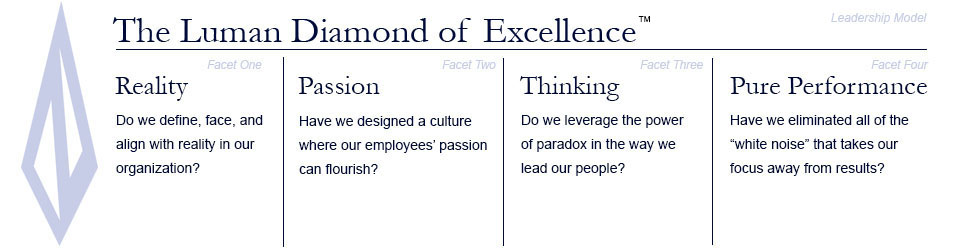
You want a model that has elegant simplicity.  We spent 25 years distilling our experience with hundreds of organizations and tens of thousans of leaders down into a model that is both straightforward and robust.  We call it the Diamond of Excellence™.  It has 4 facets that are easily grasped but rich enough to cover everything a leader needs to know and do to be top-tier effective.  We’ve been challenging leaders for the past 5 years to name one important leadership situation or challenge that isn’t covered by the Diamond, and to date no one has been able to come up with anything.

The spirit of the Diamond is captured in our tag line, Building Passionate, Thinking, Pure-Performance Organizations™ – all based on a foundation of facing and defining reality.  Please take a few minutes and check out the Diamond on our website.  Whatever you do, find a model that works – for you personally as well as for your team or organization.

Models come in all shapes and sizes.  Make sure you use one that you can build on forever.

Is Leadership Really About “Style?”

Published: July 19, 2011

There’s a lot of material out there about leadership “styles,” “personalities,” “strengths,” and a host of other things that are frankly off the mark – some of them way off the mark.  The notion is that if you look “inside” closely enough, if you understand more and more who you are and why you do what you do, you can become an effective leader.

There’s some truth in these materials that at times seem to dominate the market in leadership development.  These tools and instruments can have some value.  But not as a starting point.  If we begin here, we end up focusing too much on our personality.  We can too easily end up overfocusing on ourselves and on our ”strengths” and flaws, as we’re led unwittingly to leadership narcissism.

Real, effective leadership is first about powerful principles and practices and second about personality and style.  There are things that work for leaders; we have to learn them no matter how hard it is for us personally, or we simply will not be good leaders.  And there are things that don’t work for leaders; we have to unlearn them no matter how hard it is for us personally, or we simply will be bad leaders.

We need to assess ourselves against the very best that leaders can be.  There really is a set of principles that works with actual human beings, teams, and organizations.  Once we know what these are, we can learn how to act on or adjust our personality and style to apply them in the most effective way.  There’s just no way to be a passionate, performance-oriented, ethical leader if we don’t know what that means, if we’re making it up as we go along based on the latest “hot” self-assessment tool.

NEW! High-Performance Ethics ONLINE COURSE!

Published: April 18, 2011

We are proud to announce that our first comprehensive online interactive course is now available for instant access. This course teaches leaders how to achieve performance through the power of ethical behavior.

High-Performance Ethics includes groundbreaking principles of leadership taught by author and internationally acclaimed speaker James R. Lucas. This comprehensive 12 module course (approximately 9 hours of interactive learning) covers the 10 Timeless Principles for Next-Generation Leadership that Jim Lucas and Wes Cantrell (Former CEO of Lanier Business Systems) cover in the book, High-Performance Ethics.

To learn more or to order, click here: High-Performance Ethics Online Course

Note: To print this post, first click the title of the post, then at the bottom of the page, click “Print this Post” for a printer-friendly version.

Just what in the world are “ethics?”

Published: April 13, 2011

If you see what most large businesses, C-level leaders, and politicians are talking and writing about, you would think that it means “avoiding breaking the law and going to jail.”

But that’s like saying, “being successful means that your business doesn’t go bankrupt.” It’s true in a sense, but it’s the lowest possible level of truth. There’s a lot more to being successful than just staying in business and out of foreclosure. Just as there’s a lot more to ethics than avoiding an indictment.

Here’s the problem, and it’s huge: We train people to be unethical every day.

What? Am I kidding? Not at all. Let’s look at a typical meeting with “the boss.” He or she asks at decision time, “Do you all agree with me on this?” Ten people are in the room, and ten heads are nodding up and down. But inside, five of those heads are nodding “No.” They are pretending to agree, without really agreeing. A few of them may even think the idea is nuts.

So what do we call this? Typical company behavior? Sadly, yes. But it’s a whole lot more. It’s building lying – yes, lying – into our everyday business interactions. Inadvertently, perhaps, we’re teaching people that not speaking the truth is good for their careers. So is it any surprise that the might fudge the truth in other areas, like who made this mistake or missed this opportunity?

At Luman, we believe that ethical organizations start at the everyday level. And if you start there as a leader, you probably won’t have to spend any time worrying about ethics at the grand-jury level. Our course Leading with High-Performance Ethics addresses 10 areas that , if you get them right, will produce an ethical powerhouse from the ground up.

And yes, lead to higher performance too. Why? Well, how can you reach top performance as an organization when most of your people aren’t even telling the truth?

Note: To print this post, first click the title of the post, then at the bottom of the page, click “Print this Post” for a printer-friendly version.

NEW! Leading Passionate Teams ONLINE COURSE!

Published: February 16, 2011

We are proud to announce that our first of many online interactive courses is now available for instant access. This course, the first of five on the topic of Leading Passionate Teams, tackles the difficult area of leading teams that can deliver sustained results.

Leaders have a very difficult assignment: find a way to tap into the individual passions of team members and the collective passion of the team and to merge them all in a tightly focused direction. In this session, you’ll discover how to design, build, and lead passionate teams that deliver outstanding results by learning the 7 Keys to Effective Teams™.

The 7 Keys to Effective Teams include Vision, Intelligence, Cohesion, Tools, Openness, Results, and Sustainability. Courses include interactive exercises, video teaching by author James R. Lucas, and unique material that will help you design, build, and lead passionate teams!

To learn more or to order, click here: Leading Passionate Teams Online Course

Note: To print this post, first click the title of the post, then at the bottom of the page, click “Print this Post” for a printer-friendly version.

NEW! Maintaining Passion in Tough Times Presentation

Published: February 16, 2011

Delivered by James R. Lucas, this streaming presentation delves into how you can Maintain Passion in Tough Times.

To read more and to order, click here: Maintaining Passion in Tough Times. The DVD video version will be available soon!

Note: To print this post, first click the title of the post, then at the bottom of the page, click “Print this Post” for a printer-friendly version.

NEW! High-Performance Ethics Online Presentation

Published: December 15, 2010

Delivered by James R. Lucas, this streaming presentation delves into 10 Timeless Principles for Next-Generation Leadership. It answers questions like:

  • How do we compete with unethical businesses?
  • How do we stay focused & avoid countless distractions?
  • How do we build strong & effective working relationships?

To read more and to order, click here: High-Performance Ethics Presentation. The DVD video version will be available soon!

Note: To print this post, first click the title of the post, then at the bottom of the page, click “Print this Post” for a printer-friendly version.

NEW on Kindle! The Passion Principle

Published: November 1, 2010

We are pleased to announce that the first book in the Passionate Lives and Leaders Series, The Passion Principle: Designing a Passionate Organization is now available for the Kindle (and Kindle for iPad). You may download the eBook at Amazon.com. Continue to visit luman.co for updates as more books in the series are made available from Amazon and other eBook providers.

Note: To print this post, first click the title of the post, then at the bottom of the page, click “Print this Post” for a printer-friendly version.

Ethical Leadership

Published: September 1, 2010

Many a leader has encountered ethical dilemmas in business. Sometimes it seems that the only choice available is between ethics and results. Which will you choose?

Luman International has a different plan. We have 10 principles that will help your organization reap results from making ethical choices. In fact, we believe that the only way to have sustainable high-performance is to be an ethical organization. The examples are everywhere, from Enron to the meltdown in the financial sector. Choosing to pursue results at the expense of integrity will always blow up in your face.

Our cutting edge book, High-Performance Ethics, teaches the ten timeless principles for next-generation leadership – leadership that harnesses the power of ethics and integrity to achieve results you never thought possible. In addition to the book, we also have a course available for licensing (coming soon) or online delivery.

Note: To print this post, first click the title of the post, then at the bottom of the page, click “Print this Post” for a printer-friendly version.

Client Area Launched

Published: July 13, 2010

Thank you for your patience as we’ve overhauled our website top-to-bottom! We’re happy to announce that the overhaul is complete and we have a lot of new features to share with you. To our clients who already had a private client login, your login has moved to here: CLIENT AREA. Your username is your full email address, and your password has remained the same as before.

If you never had a private client login, you can register now absolutely free: REGISTER. Registering for an online account with us ensures that you stay up to date with our latest offerings, upcoming events, and access to more information about all of our offerings. And of course, your information is safe with us!

Here are some of the things our new client area offers:

  • Download Custom Files We’ve Prepared (reports, detailed plans, etc.)
  • Access Your Online Courses & Manage Licenses
  • Order & Manage Assessments
  • Order Discounted Books & DVD Sets with Free Shipping
  • Get Technical Support and Customer Service
  • Download Product Information
  • Manage & Update Your Profile
  • Add Users and Manage What They Can View
  • Manage Payment Information
  • Order & Manage Products
  • View & Pay Invoices
  • View Email History

Note: To print this post, first click the title of the post, then at the bottom of the page, click “Print this Post” for a printer-friendly version.

Distance Learning – Coming Soon!

Published: July 2, 2010

You may have noticed our site is undergoing some substantial changes in look and feel. It’s also getting a substantial amount of new content, but in the meantime you may find pages that are still under construction. Please excuse our mess!

The reason for the changes to the website is our new offerings coming later this Summer: Online Distance Courses (Asynchronous Self-Paced), Streaming Video, DVD sets (and companion discussion guides and handouts), and interactive case studies. We are very excited about our online courses (each of our COURSES will be available, plus a course on High-Performance Ethics), as they will allow our clients to have employees train (and earn CEU’s as applicable) on their own schedule, with the same high-quality, high-energy courses previously only offered in person.

In addition to all of our new offerings, we are revamping our client area to be more informative, comprehensive, and secure. The new client area will include the things you’re used to (like downloadable brochures, handouts, pagers, etc.) as well as links to all of your purchased or licensed online content (online courses, streaming video, discussion guides, etc.) and your billing information. As we roll out these changes, we would appreciate any feedback so that we can make your online experience as positive as our live interactions!

- Webmaster

Note: To print this post, first click the title of the post, then at the bottom of the page, click “Print this Post” for a printer-friendly version.

Walking the Walk

Published: June 24, 2010

Many companies make claims about their ethics. We’ve heard many of them in the media, like “We put our customers first” and “Safety is our most important priority.” But how often are these statements just empty words?

Unfortunately, too often companies are only as ethical as they “have to be” to skirt the rules and stay out of court. What they fail to realize is the true cost of unethical business practices. The tarnished reputations, the rare but catastrophic consequences…

Luman International doesn’t just teach ethics. We show you how ethics can lead to higher performance! Our course on High-Performance Ethics is available now for events, and will be available soon on video.

Note: To print this post, first click the title of the post, then at the bottom of the page, click “Print this Post” for a printer-friendly version.

Passion Trumps Engagement

Published: June 2, 2010

Many companies and leadership experts tout the importance of “satisfaction” and “engagement.” However, these both fail to tap into the deep commitment that passion can bring.

Employee satisfaction may not be a bad thing, but it could be a huge distraction from giving people what they really need at the core – to make a difference, to do valuable work, to count. And it could be a bad thing if it shrinks people’s souls and the organization’s performance.

Luman International has pioneered the keys to building a Passionate Organization™. Contact us today to start building passion into your organization.

Note: To print this post, first click the title of the post, then at the bottom of the page, click “Print this Post” for a printer-friendly version.

Preventing Mass Exodus

Published: May 7, 2010

A recent survey by CareerBuilder.com found that 24% of workers didn’t feel loyal to their current employer. The 2009 Employment Dynamics and Growth Expectations Report said that 55% of employees plan to change jobs, careers, or industries “when the economy recovers.” (Stafford, Diane “Look for Lots of Job Shifts” Kansas City Star, 12/05. 2009, Print)

The fact is, most organizations fail to capture the hearts and minds of their employees through the power of passion. Passionate organizations achieve true and deep engagement at all levels through leadership development and cultural design. Pure-Performance™ organizations understand how to design passion and line-of-sight into their organization. Learn more HERE.

Note: To print this post, first click the title of the post, then at the bottom of the page, click “Print this Post” for a printer-friendly version.


Homepage Graphic

About Luman International

Luman provides highly practical thought leadership to public, private, not-for-profit, and government organizations. We work with our clients to create Passionate, Thinking, Pure-Performance Organizations™ and leaders. We develop leaders into effective advocates who deeply care about and consistently advance their organization’s overall vision, mission, strategy, goals, and values.

Click to verify BBB accreditation and to see a BBB report.